Fishing in Mallorca
Identify fish in Mallorca and check minimum sizes
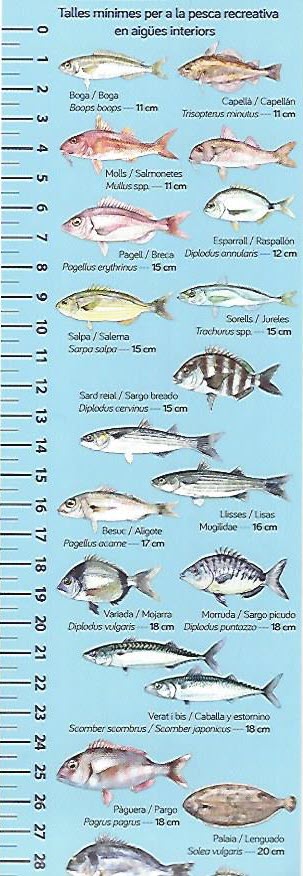
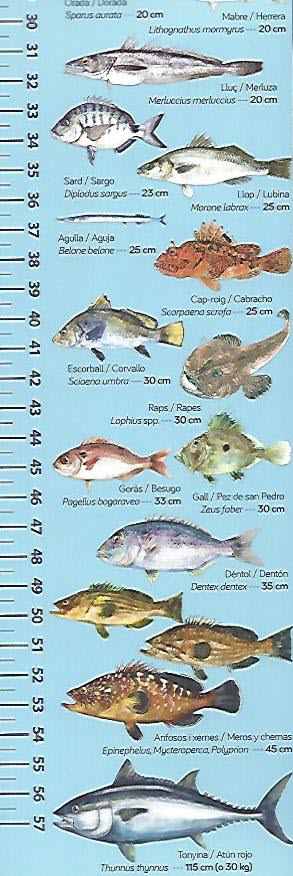
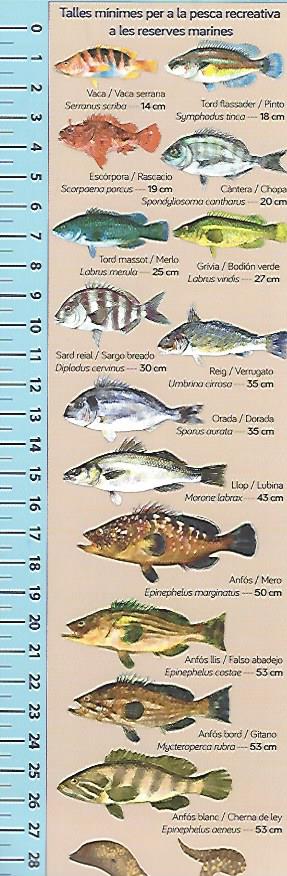
What fish is it, and may you keep it? Use identifying features and scientific names first. Then check the minimum size and the rules at the capture location. The table and existing illustrated charts help you compare.
Apply for a fishing licence for Mallorca online
From an unknown catch to the correct table entry
A similar appearance is not enough to identify a species. Work through these steps:
- Identify the species using several features; uncertainty is not a reason to keep it.
- Search the table using the scientific name. Local common names can vary.
- Check the general minimum size and any stricter marine reserve rules.
- Also check catch limits, closed seasons and any reporting requirements.
Go to the searchable minimum-size table · Go to identification tips · Identify fish: illustrated guides
Additional identification guide checked on
Mallorca & Balearics: minimum sizes by species
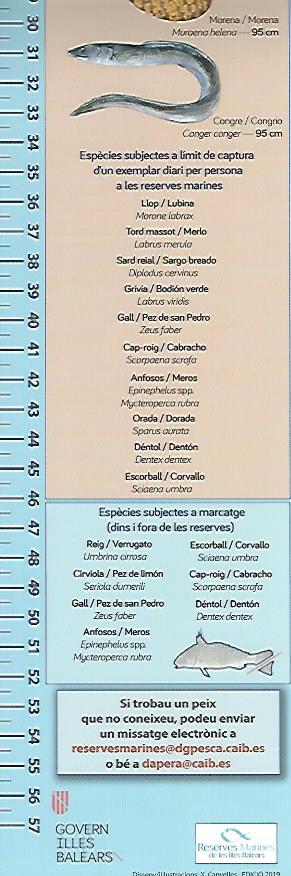
This table applies outside marine reserves. Reserves may have higher minimum sizes and additional limits on numbers caught.
Balearic Islands outside marine reserves
| Fish species | Scientific name | Minimum size / weight |
|---|---|---|
| BogueBogo | Boops boops | 11 cm |
| Poor codCapella | Trisopterus minutus | 11 cm |
| Red mulletsMolls | Mullus spp. | 11 cm |
| Common pandoraPagell | Pagellus erythrinus | 15 cm |
| Annular seabreamEsparrall | Diplodus annularis | 12 cm |
| SalemaSalpa | Sarpa salpa | 15 cm |
| Horse mackerelsSorells | Trachurus spp. | 15 cm |
| Zebra seabreamSard reial | Diplodus cervinus | 15 cm |
| Axillary seabreamBesuc | Pagellus acarne | 17 cm |
| Grey mulletsLlisses | Mugilidae | 16 cm |
| Two-banded seabreamVariada | Diplodus vulgaris | 18 cm |
| Sharpsnout seabreamMorruda | Diplodus puntazzo | 18 cm |
| MackerelsVerat i bis | Scomber scombrus / S. japonicus | 18 cm |
| Red porgyPaguera | Pagrus pagrus | 18 cm |
| Common solePalaia | Solea vulgaris | 20 cm |
| Gilthead seabreamOrada | Sparus aurata | 20 cm |
| Sand steenbrasMabre | Lithognathus mormyrus | 20 cm |
| European hakeLluc | Merluccius merluccius | 20 cm |
| White seabreamSard | Diplodus sargus | 23 cm |
| European seabassLlop | Morone labrax | 25 cm |
| GarfishAgulla | Belone belone | 25 cm |
| Red scorpionfishCap roig | Scorpaena scrofa | 30 cm |
| Brown meagreEscorball | Sciaena umbra | 30 cm |
| AnglerfishesRaps | Lophius spp. | 30 cm |
| Blackspot seabreamGoras | Pagellus bogaraveo | 33 cm |
| John DoryGall | Zeus faber | 30 cm |
| Common dentexDentol | Dentex dentex | 35 cm |
| Groupers and wreckfishAnfosos i xernes | Epinephelus, Mycteroperca, Polyprion | 45 cm |
| Atlantic bluefin tunaTonyina | Thunnus thynnus | 115 cm (or 30 kg) |
No results. Try another term.
A minimum size alone is not permission to catch a fish. Closed seasons, protected species, additional permits and the rules for the specific waters still apply.
Look closely at two seabream species
These features are an introduction, not a complete identification key. Compare body shape and the locally hosted illustrated charts further down as well.
Gilthead seabream / Dorada / Orada
Sparus aurata
Look for a gold band between the eyes and a dark blotch high on the gill cover. The gold band may be less distinct in young fish. A silver body alone does not identify the species.
General minimum size: 20 cm. In marine reserves, this species has an increased minimum size of 35 cm. Additional catch restrictions still apply.
Two-banded seabream / Variada
Diplodus vulgaris
Look for two prominent dark bands: one behind the head and another at the tail base. Do not confuse these with the gilthead seabream’s gold forehead band. Search the table by the scientific name.
General minimum size: 18 cm. Use the Diplodus vulgaris entry; other seabream species have different minimum sizes.
How to measure a fish
Measure total length from the tip of the mouth to the end of the tail fin. Read a suitable measuring scale alongside the fish; an estimated hand span is not a reliable substitute. Prepare the scale before fishing so the check can be quick.
Reaching a minimum size does not by itself permit you to keep a fish. The table includes species subject to additional restrictions. In particular, a tuna size entry must not be interpreted as permission to target or retain tuna.
Why one general size list is not enough everywhere
Marine reserves can have higher minimum sizes, additional protected species and specific catch restrictions. Establish whether your spot is inside a reserve before fishing. The name of a nearby town is not enough; the actual coastal section matters.
The existing table is a selection of species. A missing entry means neither “no minimum size” nor “capture permitted”. Illustrated charts can help with identification but may carry older measurements. For the two species described above, use the explicitly stated values and also check the local rules.
Useful details for an identification question
If the species is unclear, note the location and visible features without handling the fish for longer than necessary. A side view can show body shape, bands, fins and the tail base; a head detail can clarify markings. Colour alone can be misleading in different light.
Do not base a decision to keep a fish solely on automatic photo recognition. If the species or permission to retain it remains unclear, handle it carefully and release it promptly. Prepare your identification aid before the outing instead of searching for one after a catch.
Read the regional fishing rules for Mallorca · Mallorca coastal licence: service and application
Identify fish: illustrated guides
These illustrations help identify species but include some older minimum sizes. For example, the red scorpionfish minimum is 30 cm rather than the pictured 25 cm. Use official information and the current table when deciding whether to keep a catch.